
The Department of Animal Genetics & Breeding at the College of Veterinary & Animal Sciences, Banda University of Agriculture & Technology (BUAT), Banda serves as a pivotal academic and research unit dedicated to genetic improvement, conservation, and sustainable utilization of livestock resources. The Department focuses on integrating classical genetics, quantitative breeding approaches, and emerging genomic technologies to enhance productivity, adaptability, and resilience of domestic animal populations.
Established in accordance with the academic framework prescribed under the Minimum Standards of Veterinary Education (MSVE) of the Veterinary Council of India (VCI), the Department delivers comprehensive undergraduate instruction in principles of inheritance, population genetics, cytogenetics, quantitative genetics, selection strategies, breeding systems, and genomic applications in livestock improvement. Emphasis is placed on analytical reasoning, data interpretation, and practical exposure to genetic evaluation methods.
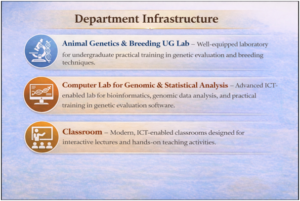
The Department is supported by well-structured infrastructure including a dedicated Undergraduate Laboratory for practical demonstrations and cytogenetic training, and a modern Computer Laboratory equipped for statistical and genetic data analysis. These facilities enable students to develop competency in breeding value estimation, genetic parameter analysis, selection index construction, and introductory genomic data handling.
With a commitment to scientific rigor, ethical breeding practices, and conservation of indigenous livestock genetic resources, the Department strives to produce professionally competent veterinarians capable of contributing to national livestock development programmes and research initiatives.
Mandate
- To impart comprehensive knowledge of animal genetics and breeding principles in accordance with MSVE–VCI standards.
- To develop practical competence in genetic evaluation, selection methods, and breeding programme formulation for livestock improvement.
- To promote application of quantitative genetics and modern genomic tools in sustainable animal production systems.
- To strengthen conservation and scientific management of indigenous and regionally important livestock genetic resources.
- To uphold ethical breeding practices, data integrity, and professional responsibility in livestock development.
Mission
- To provide quality education and practical training in animal genetics and breeding aligned with MSVE–VCI guidelines.
- To build analytical and computational skills for genetic evaluation, breeding value estimation, and data interpretation.
- To promote scientific breeding strategies for productivity enhancement and genetic improvement of livestock.
- To integrate modern genomic and biotechnological tools into teaching and applied breeding practices.
- To encourage conservation and sustainable utilization of indigenous livestock genetic resources.
- To foster ethical responsibility, research aptitude, and lifelong learning in the field of animal genetics and breeding.
Vision
To be a center of excellence in Animal Genetics & Breeding through innovative teaching, advanced research, and responsible breeding strategies, contributing to genetic improvement, conservation of indigenous livestock, and sustainable livestock development at regional and national levels.
Objectives
- To build advanced competence in genetic evaluation, quantitative breeding methodologies, and evidence-based livestock improvement strategies.
- To integrate modern genomic technologies with conventional breeding approaches for accelerating genetic gain and productivity enhancement.
- To develop expertise in designing sustainable breeding programmes tailored to regional production systems and indigenous genetic resources.
- To strengthen analytical, computational, and research capabilities for high-quality genetic data interpretation and decision-making.
- To promote ethical stewardship, conservation, and responsible utilization of animal genetic diversity for long-term livestock sustainability.

Dr Shiv Kumar Tyagi

Dr. Uma Kant Verma
CO1: Principles of Genetics
Explain Mendelian inheritance, gene interactions, linkage, and mutation.
CO2: Population Genetics
Apply Hardy-Weinberg equilibrium, gene frequency calculations, and inbreeding coefficients.
CO3: Quantitative Genetics
Estimate heritability, repeatability, genetic correlations, and variance components.
CO4: Selection Methods
Compare mass selection, family selection, progeny testing, and selection index.
CO5: Breeding Systems
Evaluate inbreeding, outbreeding, crossbreeding, and grading-up systems.
CO6: Genetic Evaluation
Perform breeding value estimation and interpret selection response.
CO7: Molecular & Genomic Tools
Understand basics of molecular markers, SNPs, and genomic selection.
CO8: Data Analysis Skills
Analyze breeding data using statistical and computer-based tools.
CO9: Professional & Ethical Conduct
Demonstrate responsible breeding practices and conservation ethics.
- Genetic Diversity and Conservation Genomics
- Quantitative Genetics and Genetic Evaluation
- Genomic Selection and Molecular Breeding
- Adaptation and Climate Resilience Genetics
- Reproductive and Performance Genetics
- Bioinformatics and Genomic Data Analytics
Coming Soon....
Coming Soon....
Coming Soon....
Coming Soon....